



2023: It's been 10 years
Ten years ago, I produced my first vintage on 3 hectares of vines. Today, the estate has become a diversified farm of 230 hectares. I cultivate and raise cereals, vines, cattle, sheep, and 34 hectares are left uncultivated to preserve essential biodiversity. I work in a field that ensures our country's food sovereignty. A field that promotes the French art of living internationally. I sequester carbon in the soil. I am proud of the work accomplished in 10 years; my children will thank me for fighting to secure their future on Earth.
Let's not get sidetracked, let's go back to how this 2023 vintage unfolded and how my philosophy was able to blend with Mother Nature.
First of all, our vines were spared from frost in the spring. We had a few mornings with sub-zero temperatures, but thanks to dry conditions, the vines were able to withstand it. This was a relief, as the colossal losses of 2021 are still fresh in our minds. Rather than investing in unnatural methods of frost protection, I favor common-sense farming practices. Winter pruning is done in two stages, and I cultivate about ten different grape varieties. Pruning allows me to delay bud break by a few days. Finally, using grape varieties that are less early-ripening than Chardonnay also allows me to sleep better at night when there is a risk of frost.

From April 1st to September 30th, 2023, we experienced an average temperature of 18.7°C, compared to a normal of 16.4°C in Burgundy. The 2.3°C difference is enormous and clearly illustrates the impact of climate change. The temperature rise far exceeds all meteorologists' forecasting models. My philosophy is to always try to find the positive in a situation, but in the context of climate change, I confess I have no confidence in our politicians.
In terms of rainfall, we had 187 mm during the spring, which is very close to the average (177 mm), and during the summer we had slightly more rain than average with 224 mm (compared to an average of 183 mm). We had thunderstorms almost every week. My vines were delighted with this weekly watering. Summer thunderstorms mean cooler temperatures and rain, but they are often accompanied by hail. At the estate, only the village of Saint-Aubin suffered significant damage, with hailstones reaching the size of tennis balls.
Water is life. Without water, nothing grows; if nothing grows, the water cycle is broken. Many people imagine that water comes from the sky. That's wrong! Rain comes from the ground. Just look at the water cycle diagram we learned in primary school. In the 1960s, we destroyed enormous areas of hedgerows and wild landscapes in favor of intensive agriculture. Hedges, forests, and fallow land were important sources of moisture, beneficial for evapotranspiration. That's why I place great importance on the extensive farming model I practice on my farm.

From the end of July onwards, the fatigue of the winemaking season sets in every year. It's time for my team to take a break, but I prefer to remain vigilant. At the end of the growing season, the vines need to be watched like a hawk. Going on vacation would be a bit like leaving my kitchen while I'm still cooking a steak.
I have some plots that ripen quickly and others that take longer. Meursault 1er Cru Perrières is the earliest-ripening plot. This plot dictates when the harvest begins. I compare 2023 to 2018. The vines benefited from quite favorable conditions, with yields between 35 and 55 hl/ha and perfect balance. Thanks to meticulous organization, we harvested over three weeks. A tremendous amount of work was carried out during those three weeks, but with the satisfaction of harvesting a healthy and bountiful vintage.
In the winery, the philosophy has remained the same since my first vintage. The terroir must express itself with as little intervention, energy, or manipulation as possible. For the white wines, settling takes place after 12 hours, alcoholic fermentation begins in tank, and then, halfway through fermentation , the wine is transferred to barrels. With low malic acid levels, almost no sulfites, and summer-like ambient temperatures, malolactic fermentation proceeds rapidly. This natural process allows me to take advantage of the winter cold to tartaricize the wines.

For reds, my credo is whole-cluster fermentation. I have a destemmer, but I think I'll sell it because I've hardly ever used it. Optical sorters and the like cost a fortune and make me nauseous. Emmanuel Reynaud uses a 1980s-era grape pump to vat his Grenache and makes some of the most sought-after wines in the world. After vatting, the rule is very little punching down, very little pumping over, very little heat, very little cold; I let the cuvée ferment at room temperature. Only the most elegant tannins should be extracted. This approach allows me to obtain fine, ethereal, complex wines with good aging potential and, above all, utterly authentic.
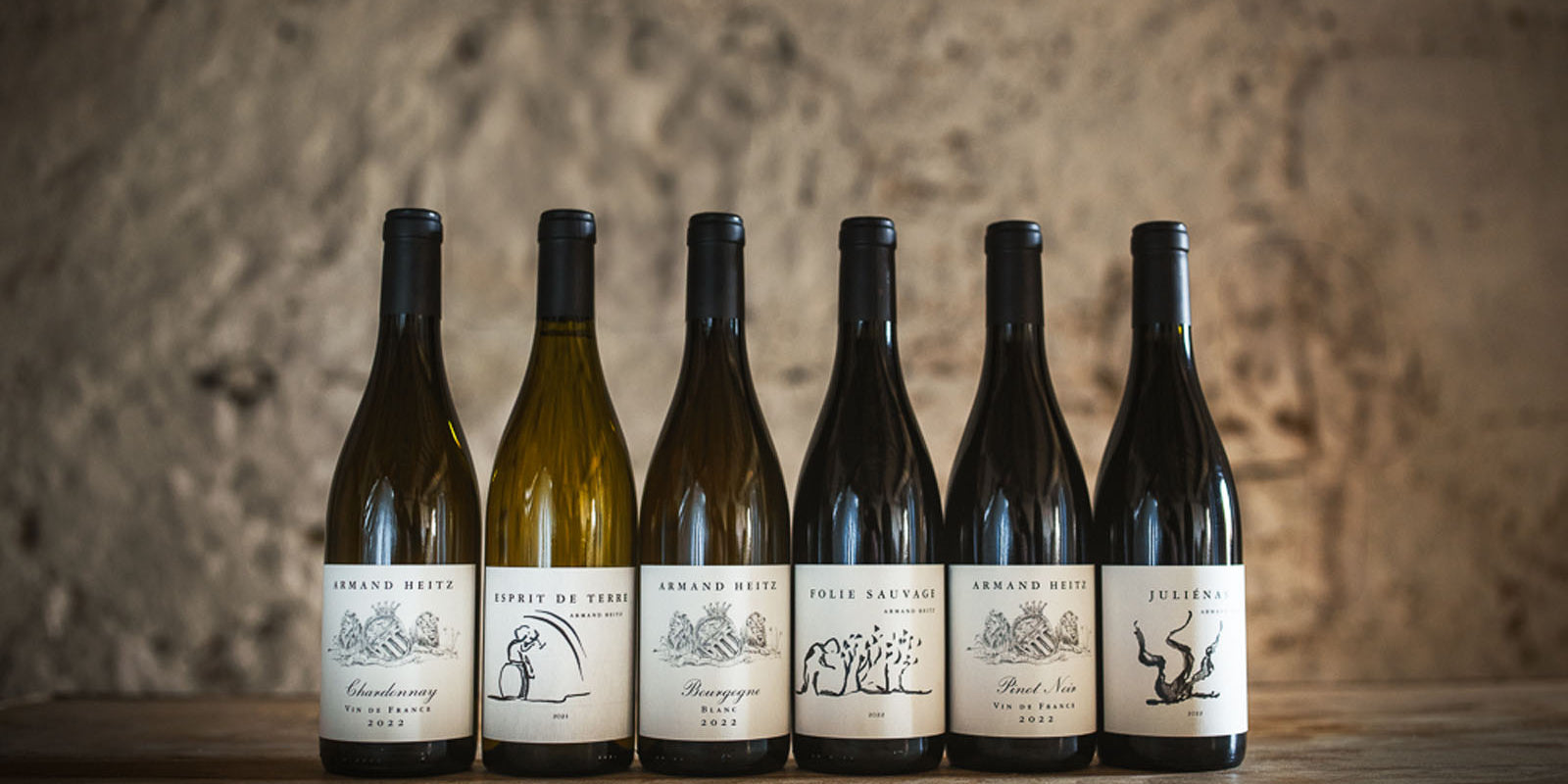
As we present our wines to journalists and clients, I am very proud of the work accomplished in 2023. In addition to adhering to a highly committed ethical approach, my wines are excellent. Both the white and red wines are perfectly balanced, with precise and complex aromatic intensity. On the palate, the volume is incredible, and the extraction is masterfully controlled.
→ Click here to discover the 2023 vintage
Armand Heitz
